
 What if the stories your child loves are shaping an identity that isn’t theirs?
In the recent GIPNet webinar on Children’s Positive Identity Formation: Nurturing Hearts and Minds with Stories That Uplift, Dr. Fawzia Gilani-Williams, an award-winning children’s author, educator and researcher shared a fascinating observation from her work in the desert. When children were asked to draw a house, they drew peaked roofs, chimneys and apple trees, even though they lived where palm and date trees were everywhere.
Why? Because children often draw what they repeatedly see, hear and experience through books, stories and their surroundings. It is a simple observation, but it carries a powerful message. Children are constantly absorbing images of what is normal, beautiful, desirable and possible. This raises an important question for Muslim parents and educators: Are our children’s books reflecting their world, their faith and their identity?
Stories Are Powerful
Every story we tell our child shapes, in some way, their character and identity.A story teaches more than words. It introduces children to ideas about what is good, beautiful, courageous and worth pursuing. It presents models of how people behave, respond to difficulties, treat others, and make choices. Yet, some parents are more interested in little more than academics and reading as a measure of academic performance. For such parents, reading is seen as little more than a way of securing good grades, developing vocabulary or preparing children for examinations.
When reading is viewed only as an academic skill, we may overlook its deeper influence. Stories can shape imagination, values, attitudes and aspirations. They can influence how children understand themselves and how they see the world. The stories children repeatedly encounter can become part of the mental picture they develop about themselves and the world around them. As parents, we should choose stories that build faith, courage and hope. Choose stories that help children recognise goodness, overcome difficulties, appreciate others and care about people.

Dr Fawzia Gilani-Williams at an event.
Why Mirrors Matter
Internationally recognised for her work, Dr. Fawzia Gilani-Williams is a recipient of the prestigious Sydney Taylor Book Award Silver Medal Honour. I met her at a recent event, where she explains why Muslim children need mirror books, not just storybooks. Most books Muslim children read are window books. They look into someone else’s world. There is tremendous value in this. Children should discover different cultures, communities, experiences and ways of life. But children also need to see themselves. Mirror books reflect aspects of a child’s faith, culture, family, experiences and values. They send a powerful message: “You belong. Your story matters. Your way of life is worth seeing.” When children see themselves positively represented, they do more than enjoy a story. They begin to understand who they are and who they can become. Representation is therefore not simply about inclusion. It is about identity, confidence, belonging and validation. Children cannot aspire to what they cannot see.
Windows Into Other Worlds
But mirrors alone are not enough. Children also need window books that help them discover and appreciate people from different backgrounds. Stories can take children beyond their immediate experiences and introduce them to unfamiliar cultures, circumstances and perspectives. The Qur’an reminds us:
“We created you from a male and a female, and made you into peoples and tribes so that you may know one another.” ~ (Al-Qur’an 49:13)
Window books can help children “know one another”. They broaden perspectives, nurture empathy and help children appreciate the diversity of Allah’s creation with respect and compassion. When a child reads about someone who is lonely, the child gets an opportunity to imagine loneliness. When a character experiences exclusion, the child can begin to understand what exclusion feels like. When someone reaches out with compassion, the child sees what caring for another person looks like. Stories allow children to practise seeing the world through another person’s eyes. And that is an important foundation for empathy.
Growing Hearts
Perhaps this is the beauty of having both mirrors and windows. The mirror tells a child, “You matter. Your story matters. Your identity matters.” The window tells a child, “Others matter too. Their stories matter. Take the time to understand them.” Together, they can nurture children who are secure in their identity while remaining open-hearted towards others.
This is where stories connect beautifully with the values we want to cultivate in our children. A child who reads about courage can learn to face difficulty with hope. A child who encounters characters who forgive can begin to understand mercy. A child who sees generosity celebrated may become more attentive to the needs of others. A story does not guarantee a particular response. But it can plant a seed, open a conversation and give a child a picture of what goodness can look like.
Beyond the Bookshelf
Of course, books are not the only teachers. Children also learn by watching us. They notice how we speak to one another. They observe how we respond to mistakes, how we treat people who serve us, how we talk about those who are different from us and what we do when someone needs help. A book may introduce a lesson, but everyday life reinforces it. If we want children to value compassion, they need to experience compassion. If we want them to respect differences, they need to see respectful conversations at home. If we want them to have strong faith, they need to see faith lived with confidence and joy.
Choosing Stories With Intention
So, the next time you choose a book for your child, ask more than, “Is this entertaining?” Ask: What is this story teaching my child about himself? What does it teach him about other people? Whose experiences does it make familiar? Who gets to be the hero? What values are celebrated, recognised, acknowledged, validated? Does my child see aspects of his identity reflected? Does the story encourage empathy, courage and hope?
Every story leaves something behind.
Our children are constantly building mental pictures of what is normal, beautiful, admirable and possible. Let us give them stories that help them see themselves with dignity, see others with understanding and see the world with wonder. Let us raise children who are confident in their faith, and anchored in their purpose. Every child deserves to see themselves in a story. Every child deserves to belong.
Watch the GIPNet webinar: Children’s Positive Identity Formation: Nurturing Hearts and Minds with Stories That Uplift
To know more about Dr Fawzia Gilani-Williams’ work, visit her website: https://fawziagilani.com/

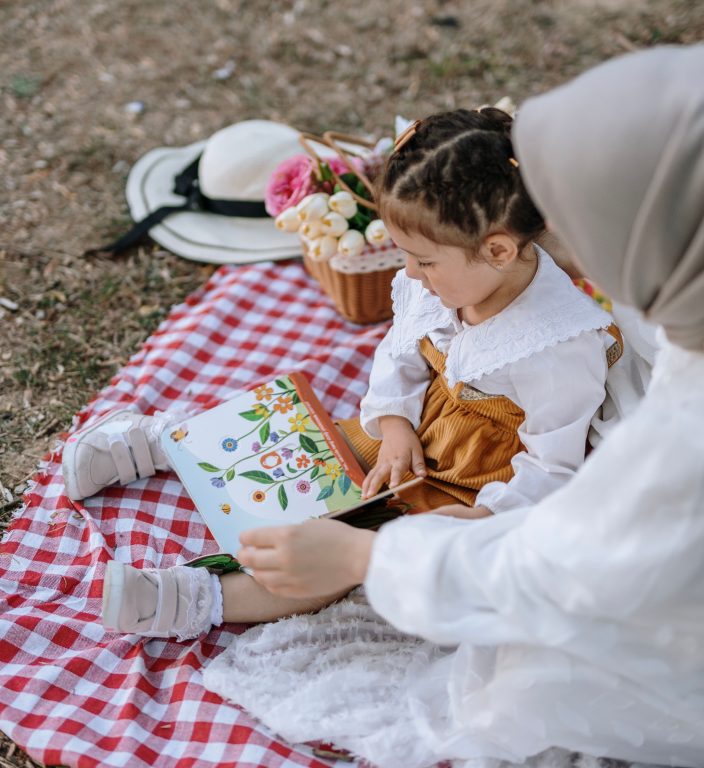
Featured image by casper somia