



What children’s developing brains need, and why waiting, talking and even a little boredom matter.
Imagine this familiar scene.
A family arrives at a restaurant. The parents settle into their seats, place their orders and wait for the food. Within minutes, the youngest child becomes restless.
“Mummy/Daddy, when is the food coming? Can I have your phone?”
Perhaps the child starts climbing onto the chair, making noises or bothering a sibling. Out comes the smartphone or tablet. Almost instantly, the child becomes quiet, eyes fixed on the screen, fingers scrolling, completely absorbed. Peace, at last.
For many parents, it feels like a small victory. But have we considered what children might be missing when screens regularly take over mealtimes? More importantly, are we simply keeping our children occupied, or are we helping them develop the skills they will need to manage themselves?
This question goes to the heart of leadership in parenting.
Why Parents Reach for Screens
Before discussing the risks, we need to acknowledge something important: parenting children can be exhausting.
Sometimes, parents hand their children a device simply because they need a break. Perhaps they have been working all day, are juggling several children, or just want to enjoy a meal without constant interruptions. There is also the pressure of being in public. Nobody wants their child screaming in a restaurant while other diners stare disapprovingly.
A 2022 Australian study by Mallawaarachchi and colleagues, involving interviews with 45 caregivers, found that convenience, family circumstances and social expectations influenced decisions to give young children mobile devices. Some parents felt judged when their children misbehaved in public. Others worried about being judged for allowing screen use. Either way, they felt caught between competing expectations.
This is why telling parents simply to “stop giving children screens” isn’t particularly helpful. Parents need understanding, support and realistic alternatives. The greater concern is when reaching for a device becomes the automatic response to every moment of boredom, frustration or waiting.
What Happens to the Developing Brain?
Children’s brains are still developing the skills needed to manage attention, emotions and behaviour. Among these are executive functions, which include working memory, flexible thinking and inhibitory control. Inhibitory control is what helps a child resist an impulse, wait for a turn or stop themselves from acting immediately on every desire. These skills develop gradually through everyday experiences, relationships and practice.
Consider a child waiting for food. The child feels impatient and perhaps begins to complain. A parent acknowledges their frustration and suggests a game, a conversation or simply looking around. The child is not merely passing time. With guidance, they have an opportunity to practise managing an uncomfortable feeling.
Now imagine that every time waiting becomes difficult, the child immediately receives a screen. The device may provide relief, but it can also replace opportunities to practise other ways of coping.
A 2023 study by Radesky and colleagues followed 422 children aged three to five. Frequent use of mobile devices to calm upset children was associated with greater emotional reactivity over time, particularly among boys and children with certain temperamental characteristics. The study raises an important parenting question: Are we helping children learn to manage their emotions, or are we repeatedly managing those emotions for them through a device?
Leadership in parenting encourages us to look beyond the immediate behaviour. Instead of focusing only on stopping a child from complaining, we consider what the child needs to learn. A child who struggles to wait does not necessarily need punishment or a lecture. They may need guidance, encouragement and repeated opportunities to practise patience.
Why the First Two Years Deserve Special Attention
For infants and toddlers under two, the developmental considerations are different. Their brains are developing rapidly, and they learn primarily through direct sensory experiences, movement and responsive interactions with caregivers. A baby learns through looking at faces, listening to familiar voices, reaching for objects and exploring their surroundings. When a parent smiles, responds to a baby’s babbling or points out something interesting, these simple exchanges support early communication and learning.
Think of it this way: just as nutritious food helps a baby’s body grow, meaningful interactions help nourish their developing brain. Talking is brain food, even before a child can speak.
When a baby babbles and a parent responds, the interaction is more than a pleasant exchange. It provides opportunities for the baby to hear language, notice expressions and gradually learn the rhythm of communication. These back-and-forth interactions help support the development of neural connections involved in learning and communication.
Recent research reinforces the importance of protecting these experiences.
A 2023 Japanese study by Takahashi and colleagues, involving 7,097 mother–child pairs, found that greater screen exposure at one year of age was associated with a higher likelihood of developmental delays in communication and problem-solving at ages two and four. The findings raise concerns about extensive screen exposure during infancy.
A 2024 systematic review and meta-analysis by Mallawaarachchi and colleagues, covering 100 studies and 176,742 participants, also found that the context of screen use matters. Background television and greater programme viewing were associated with poorer cognitive outcomes, while caregiver screen use during children’s routines was associated with poorer psychosocial outcomes.
We need to prioritise real-world interaction and recognise the developmental differences between young toddlers and older children. For babies, the question is therefore not how we can keep them entertained throughout a restaurant visit, but how we can respond to their needs while giving them opportunities to interact with the world. Unlike older children, babies are not developmentally ready to practise patience in the same way. A crying infant may be hungry, tired, overstimulated or simply seeking comfort. What they need is responsive care, not a lesson in waiting.
Habitual Screen Use and the Rise of “Brain Rot”
The expression brain rot has become increasingly popular, particularly in discussions about short-form videos and endless scrolling. Researchers are beginning to investigate the attention difficulties, compulsive behaviour and cognitive dependence associated with excessive digital content consumption.
A significant 2025 meta-analysis by Nguyen and colleagues examined 71 studies involving 98,299 participants. Greater consumption of short-form videos was associated with poorer cognitive performance, particularly attention and inhibitory control. These associations were found across youth and adult samples. If these are the effects on youth and adults, imagine what it does to the brains of younger, vulnerable children.
Another study published in 2026 by Telzer and Burnell examined smartphone habits among 79 adolescents aged 11 to 18. Participants checked their phones an average of approximately 64 times during the school day. More frequent checking was associated with poorer performance on a cognitive-control task. The study was relatively small and observational, but its findings highlight an important distinction: It isn’t only how much time children spend on devices that matters. How frequently they reach for them, and whether the behaviour becomes habitual, deserves attention too.
In 2025, researchers developed a Brain Rot Scale to investigate problematic digital consumption among young people aged 8 to 24. The scale examines difficulties regulating attention, compulsive device engagement and perceived cognitive dependence. It is an emerging research concept. For parents, the practical concern is straightforward. When a child repeatedly turns to digital entertainment whenever nothing exciting is happening, are we helping them become more capable of occupying themselves, or less accustomed to doing so without a screen?

Talking Is Brain Food
A family meal offers much more than food. It is an opportunity for conversation, storytelling, listening, observing social behaviour and strengthening relationships.
Food nourishes the body; conversation nourishes the brain. Just as growing children need a variety of nutrients to develop physically, their developing brains benefit from a rich variety of experiences, including language, interaction, exploration and problem-solving. Imagine serving your child a nutritious meal but allowing a screen to occupy their attention throughout dinner. Their physical hunger may be satisfied, but valuable opportunities for conversation and connection may have been missed.
When a child asks a question, listens to an explanation, shares a story or responds to another person’s comment, they are engaging in exchanges that help develop language, thinking and social understanding. A conversation also gives children opportunities to practise paying attention, taking turns and considering another person’s perspective.
This is particularly important for young children, whose language abilities develop through repeated interactions with the people around them. A 2024 Australian study by Brushe and colleagues followed 220 families with children aged 12 to 36 months. Using audio recordings, researchers found that greater screen exposure was associated with fewer adult words, child vocalisations and conversational exchanges. The study examined everyday screen exposure rather than restaurant meals specifically, but it illustrates how screens may displace opportunities for parent–child communication.
The beauty of these interactions is that parents do not need to prepare elaborate lessons. Simply talking about the food, asking children about their day, explaining something they notice or sharing a funny story can create meaningful opportunities for learning. And parents need to look at their own habits, too. Another 2024 study by Radesky and colleagues examined 47 recorded family mealtimes. When mothers were texting or scrolling, they tended to engage in less verbal interaction and were less responsive to their children’s attempts to communicate.
Children notice what adults do. If we want them to put their devices away during meals, we need to demonstrate that family conversations deserve our attention as well. The next time you sit down for a meal with your children, remember that you have an opportunity to nourish both their bodies and their minds.
Leadership in Parenting Begins With Leading Ourselves
We often think of parental leadership as setting rules, establishing boundaries and teaching children what is right. But effective leadership begins with our own behaviour. Imagine a parent telling a child, “Put your phone away. We’re having dinner,” while continuing to scroll through messages. What lesson is the child receiving? Children learn less through our instructions and more by observing how we manage ourselves. When parents put their phones aside, listen attentively and participate in family conversations, they demonstrate the behaviour they hope their children will develop.
Leadership in parenting is not simply about getting children to obey. It is about guiding them towards becoming individuals who can think, make wise decisions and manage their own behaviour. This requires a gradual shift from external control to internal self-discipline. A young child may need frequent reminders, encouragement and close guidance. As children mature, they should gradually take greater responsibility for their choices. We cannot expect children to become independent overnight, but we can begin preparing them through small, everyday experiences. Mealtimes are a wonderful place to start.
What Can We Give Children Instead?
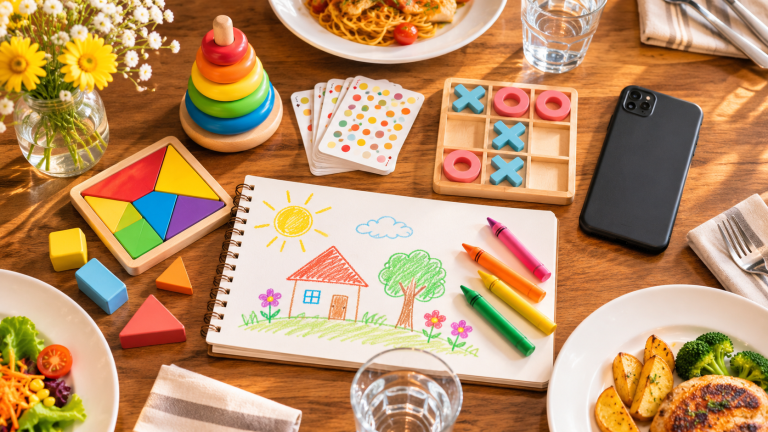
In reality, the alternatives need not be expensive, complicated or exhausting. What works best will depend on children’s ages, interests and developmental abilities.
For infants under 12 months: Focus on comfort, interaction and sensory exploration. Talk to your baby, imitate their sounds, sing softly or play peekaboo when developmentally appropriate. Offer an age-appropriate soft book, a lightweight rattle or a safe teething toy. Even watching a parent’s facial expressions can be engaging for a young baby. If the baby is hungry, tired or overstimulated, respond to those needs rather than trying to distract them.
For toddlers aged 12–23 months: Try sturdy board books, simple pointing games, large stacking cups or familiar songs with actions. Name objects around the restaurant and encourage your toddler to identify them. For example, “Where is the spoon?” or “Can you see the big window?” At this age, activities may hold attention for only a few minutes, so parents should be prepared to change activities or take a short movement break. Toys should be age-appropriate, closely supervised and free from choking hazards.
For children aged 2–4: Bring a small picture book, a reusable drawing board or a few age-appropriate finger puppets. Play simple observation games such as “Find something red” or “How many lights can you see?”
For children aged 5–7: Try colouring, reusable stickers, I Spy or guessing games. Ask them to draw their favourite meal or imagine what kind of restaurant they would open.
For children aged 8–12: Introduce word games, riddles, memory challenges or Twenty Questions. Let them explore the menu, compare prices or help work out the bill.
For teenagers: Invite them into real conversations. Ask their opinions, discuss something interesting, plan a family activity or simply listen to what matters to them. Not every conversation needs to be educational. Sometimes, laughing together over something silly is enough.
Parents can also prepare a small restaurant activity pouch containing a notebook, coloured pencils, simple puzzles or a compact card game for older children. For babies and toddlers, choose a few safe, familiar toys instead. Rotate the items occasionally to maintain interest.
But here’s an important point: We don’t have to replace every minute of screen time with another form of entertainment. Older children can sometimes simply observe their surroundings, listen to conversations or sit quietly. The aim is not to keep them endlessly occupied. It is to help them gradually become more comfortable when there is nothing immediately entertaining to do.
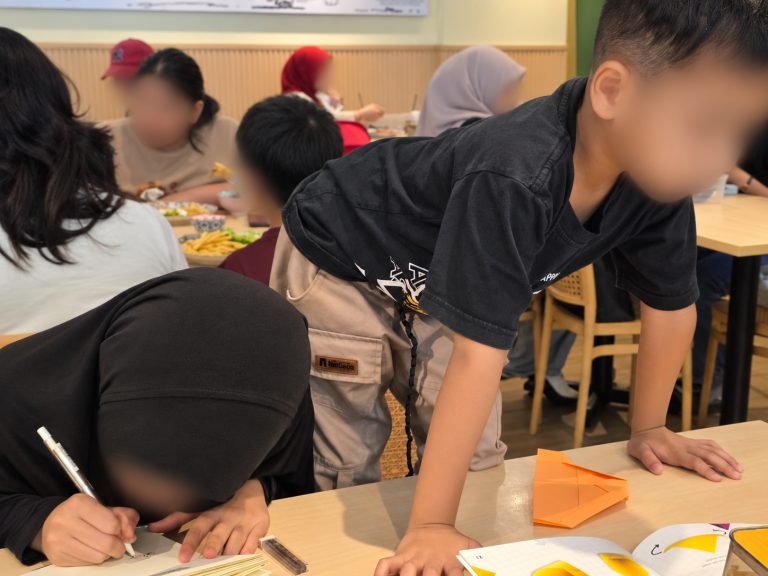
Screen-free fun. A little preparation goes a long way.
If you’re wondering whether screen-free activities at restaurants can really work, the above photo is proof that it can be done. A few days ago I saw two children happily occupied while waiting for their food. One was busy drawing on her sketchpad, while the other was making paper planes. Not a screen in sight. What struck me was that their parents had come prepared. t’s a wonderful reminder that keeping children engaged doesn’t have to be complicated or expensive. Sometimes, a notebook, a pen and a few sheets of paper are all it takes.
But What About Boredom?
Many parents feel compelled to rescue children from boredom. Yet boredom itself is not necessarily a problem that needs immediate intervention. When children are bored, we can encourage them to think of something to do, observe their surroundings or engage with the people around them.
Consider the difference between these two responses. A child complains, “I’m bored!” One parent immediately offers a phone. Another responds, “I know waiting isn’t much fun. What do you think we could do while we wait?”
The second parent is not simply keeping the child occupied. They are inviting the child to think, make a choice and take some responsibility for managing the situation. This is a small example of Leadership in Parenting in action. Instead of always providing the solution, we gradually teach children to find solutions themselves.
Of course, this doesn’t mean ignoring a distressed child or expecting a toddler to sit quietly for an hour. Young children have limited capacities for patience and emotional regulation. They need movement, reassurance and realistic expectations. A hungry, overtired or overwhelmed child may need food, rest, a walk outside or comforting attention rather than another lesson in patience.
For infants, the emphasis should remain on responsive caregiving. Babies communicate through crying, movement, facial expressions and sounds. Responding sensitively to these signals helps them feel secure and supported as they gradually develop their ability to regulate emotions. Good parental leadership combines clear direction with empathy, patience and an understanding of the child’s developmental needs.
Start Small, Not Perfect
Preparation is key. Tell your children beforehand what to expect, bring a couple of simple activities and give them a choice between drawing and playing a guessing game. Agree that the adults will put their phones aside, too. For families with infants, planning can make a significant difference. Whenever possible, choose a restaurant at a suitable time, allow for feeding and naps, and be prepared to take short breaks. Sometimes, a baby simply needs to be held, fed or taken somewhere quieter. Consistency matters more than perfection. Leadership in parenting does not require us to control every moment of our children’s lives. It asks us to be intentional about the habits we cultivate, the examples we set and the abilities we help our children develop.
Raising Children Who Can Lead Themselves
One day, our children will face situations when nobody is available to entertain them, distract them or immediately resolve their frustrations. They will need to wait, make decisions, manage impulses and regulate their emotions. These abilities do not suddenly appear when children become teenagers or adults. They develop gradually, through many small experiences throughout childhood.
For infants, the foundation begins with responsive care and meaningful interaction. As children grow, those early experiences can be followed by increasing opportunities to make choices, solve problems, practise patience and take responsibility for their actions. A few minutes spent waiting for dinner may seem insignificant. But those ordinary moments offer opportunities for children to practise patience, conversation, observation and self-control.
The next time your child asks for a phone while waiting for food, consider offering a conversation, a small activity or a little encouragement to observe the world around them. Parenting is not about getting every decision right. What matters is recognising that we have choices. Ultimately, leadership in parenting is about preparing children to lead themselves, so that even when we are not beside them, they are increasingly capable of making wise decisions and managing their own behaviour. Our goal is not simply to raise children who know how to stay quiet. It is to raise children who gradually learn how to manage their attention, emotions and behaviour. And sometimes, that learning begins with something as ordinary as waiting for dinner.

Selected Research and References (2022–2026)
- Mallawaarachchi, S. R., et al. (2022). “You’re damned if you do, you’re damned if you don’t”: A qualitative exploration of parent motives for provision of mobile screen devices in early childhood. BMC Public Health. https://doi.org/10.1186/s12889-022-14459-0
SKIP - Radesky, J. S., et al. (2023). Longitudinal associations between use of mobile devices for calming and emotional reactivity and executive functioning in children aged 3 to 5 years. JAMA Pediatrics. https://doi.org/10.1001/jamapediatrics.2022.4793
SKIP - Takahashi, I., et al. (2023). Screen time at age 1 year and communication and problem-solving developmental delay at 2 and 4 years. JAMA Pediatrics. https://doi.org/10.1001/jamapediatrics.2023.3057
SKIP - Brushe, M. E., et al. (2024). Screen time and parent-child talk when children are aged 12 to 36 months. JAMA Pediatrics. https://doi.org/10.1001/jamapediatrics.2023.6790
SKIP - Mallawaarachchi, S., et al. (2024). Early childhood screen use contexts and cognitive and psychosocial outcomes: A systematic review and meta-analysis. JAMA Pediatrics. https://doi.org/10.1001/jamapediatrics.2024.2620
SKIP - Radesky, J. S., et al. (2024). Maternal mobile device use and mealtime interactions with children. Journal of Developmental & Behavioral Pediatrics. https://doi.org/10.1097/DBP.0000000000001317
SKIP - Nguyen, L., et al. (2025). Feeds, feelings, and focus: A systematic review and meta-analysis examining the cognitive and mental health correlates of short-form video use. Psychological Bulletin. https://doi.org/10.1037/bul0000498
SKIP - Mostafa, M. M., et al. (2025). Development and psychometric validation of the Brain Rot Scale: Measuring digital content overconsumption among Generation Alpha and Generation Z. European Journal of Investigation in Health, Psychology and Education. https://doi.org/10.3390/ejihpe15120262
SKIP - Telzer, E. H., & Burnell, K. (2026). Smartphone use during school hours and association with cognitive control in youths aged 11 to 18 years. JAMA Network Open. https://doi.org/10.1001/jamanetworkopen.2026.1092
SKIP - American Academy of Pediatrics. (2026). Digital ecosystems, children, and adolescents: Policy statement. Pediatrics. https://doi.org/10.1542/peds.2025-075320